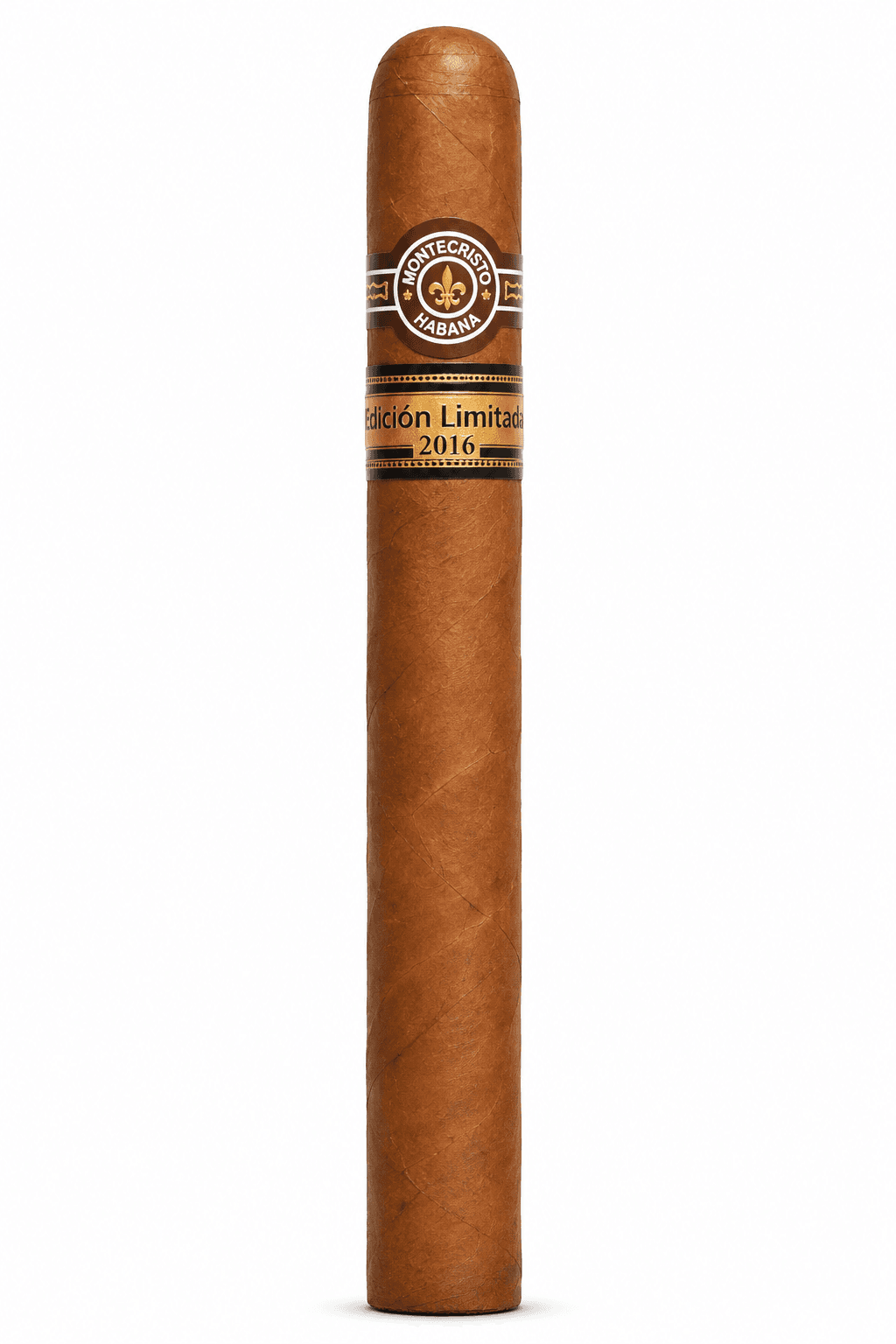
Guides
Montecristo No. 2: Size, History and the Piramides Vitola
The Montecristo No. 2 is a Cuban cigar in the Piramides vitola de galera, with a ring gauge of 52 and a length of 156 mm, and it is one of the Montecristo sizes that predate 1960. It has a tapered head and is often called a torpedo, although its Cuban factory name is Piramides.
What the No. 2 is
"No. 2" is a name, not a measurement. In the Montecristo range the numbers label individual sizes, and the No. 2 is the one built on a pyramid-type shape: wide at the foot, narrowing along the whole body to a pointed head. It is a hand-made cigar whose reference data give 52 x 156 mm (6 1/8 inches in imperial terms) and a weight of roughly 14 g.
It is among the best-known examples of a shaped cigar, or figurado, in the Cuban catalogue. If you are new to the vocabulary, the entries on parejos and figurados and on reading factory vitola names explain the terms used below.
The Piramides vitola de galera
Every Cuban size has two names: the commercial name on the box and the vitola de galera, the factory name that identifies the shape and size in the rolling room. For the No. 2 the factory name is Piramides, and it fixes the dimensions: a ring gauge of 52 measured at the widest point, the foot, and a length of 156 mm.
Because the diameter changes along the cigar, the ring gauge describes only the foot. The head is far narrower, which is why a pyramid is cut or pierced differently from a straight-sided cigar. The general theory of the shape is covered in the pyramid entry, and the difference from the straight-bodied pointed shape is explained in torpedo and belicoso. This profile does not repeat that material; it concentrates on the No. 2 itself.
Presentations reported for the No. 2 include boxes of 10, 15 and 25 and a ten-cigar aluminium pack. Availability changes over time, so the current catalogue of the producer is the reliable reference.
Montecristo No. 2 compared with other numbered Montecristos
The table sets the No. 2 beside the other core numbers and beside the Especiales No. 2, a different cigar that is regularly confused with it because of the similar name.
| Vitola | Vitola de galera | Ring gauge | Length (mm) | Note |
|---|---|---|---|---|
| Montecristo No. 1 | Cervantes | 42 | 165 | Straight-sided, parejo |
| Montecristo No. 2 | Piramides | 52 (at the foot) | 156 | Tapered head, figurado |
| Montecristo No. 3 | Corona | 42 | 142 | Straight-sided, parejo |
| Montecristo No. 4 | Mareva | 42 | 129 | Straight-sided, parejo |
| Montecristo Especiales No. 2 | Laguito No. 2 | 38 | 152 | Slim parejo, a separate line |
The practical differences follow from the table. The No. 2 is the only one of the four numbered cigars with a shaped head and a 52 gauge, so it is thicker at the foot than the No. 1, No. 3 and No. 4, which all share a 42 gauge and differ mainly in length. The No. 4 is the shortest of the group.
History within the Montecristo marca
Montecristo is generally dated to the mid-1930s, and the No. 2 is counted among the original, pre-1960 sizes of the marca rather than among later additions. Sources differ on the exact year and circumstances in which the No. 2 first appeared, so this article gives no specific date for it. The marca's origins, its name and its link with the house of H. Upmann are set out in the Montecristo history entry.
For a look at how another famous marca organises its sizes, see the Cohiba history entry. Each house has its own naming habits, and comparing them is a useful exercise in itself.
Cuban and non-Cuban "Montecristo"
The name Montecristo is also used for cigars made outside Cuba, and those products are a separate brand with their own blends, sizes and numbering. A "No. 2" from a non-Cuban line should therefore not be assumed to be the same cigar as the Cuban Piramides described here, even where the packaging looks similar. The reasons the same name can exist in two places are explained in same-name Cuban and non-Cuban brands.
Cutting and handling a tapered head
A pointed head offers more than one way to open the cigar, and the choice affects how the draw feels. A cut that is too deep can loosen the wrapper, so a cautious first cut is sensible. The options are described in cutting figurados.
Like all tobacco products, cigars are harmful to health and nicotine is addictive. This content is for adults only and is not an encouragement to smoke.
Frequently asked questions
What is the difference between the Montecristo No. 2 and No. 4?
They differ in shape and size. The No. 2 is a Piramides with a tapered head, a 52 ring gauge at the foot and a length of 156 mm. The No. 4 is a straight-sided Mareva with a 42 ring gauge and a length of 129 mm, so it is both thinner and shorter.
What is the difference between Cohiba and Montecristo?
They are two separate Cuban marcas with their own histories, bands and ranges of sizes. Montecristo uses a numbered system for its core sizes, as the table above shows. The background of each marca is covered in the Cohiba entry and the Montecristo entry.
What is the difference between Cuban and Dominican Montecristo?
They are different brands that happen to share a name, made in different countries with their own blends and ranges. The Cuban Montecristo is the one described in this profile. See same-name Cuban and non-Cuban brands for how such pairs arise.
Is the Montecristo No. 2 a torpedo?
It is commonly called one, and the word is understood by most smokers, but the factory name is Piramides. In strict terms a pyramid tapers along the whole body, while a torpedo has a mostly straight body and a pointed head. The distinction is explained in torpedo and belicoso.
What is the Montecristo Especiales No. 2?
It is a different cigar. The Especiales No. 2 uses the Laguito No. 2 vitola de galera, at 38 ring gauge and about 152 mm, and is recorded as a 1969 release. It is slim and straight-sided, and should not be confused with the pyramid-shaped No. 2. The Laguito shapes are covered in the Laguito family entry.
Reader questions
Questions & answers
No questions yet. Ask the first one.